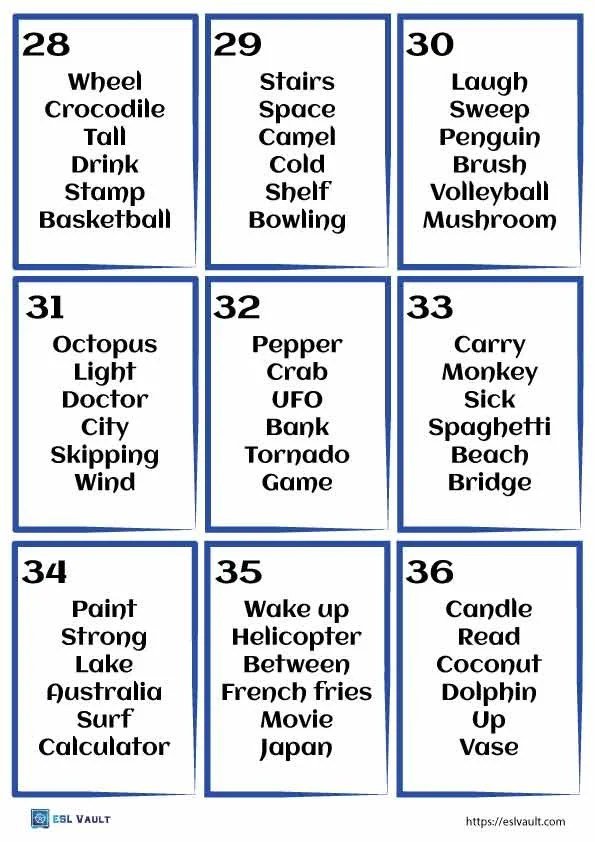
Tired of the same old Pictionary game where "cat" and "tree" are drawn in seconds? Ready to elevate your game night from casual fun to a cerebral showdown of wit, creativity, and frantic scribbles? Then you've come to the right place. Delving into Hard Pictionary Words & Phrases isn't just about making the game harder; it's about making it infinitely more engaging, hilarious, and memorable.
Forget those easy wins. We’re talking about words and concepts that demand genuine ingenuity from the artist and next-level deduction from the guessers. This isn't for the faint of heart, but for those who crave a challenge, it's a game-changer.
At a Glance: Your Blueprint for a Pictionary Masterclass
- Why Go Hard? Discover the hidden joys of pushing Pictionary boundaries and why difficulty actually enhances the fun.
- The Anatomy of a "Hard" Word: Unpack the different types of words that stump even the most seasoned players.
- Mastering the Draw: Learn advanced strategies for illustrating the seemingly impossible.
- The Art of the Guess: Hone your deductive reasoning to crack complex visual puzzles.
- Curated Word List: A definitive collection of challenging words and phrases, categorized for strategic gameplay.
- Game Night Setup: Tips for structuring your Pictionary challenge for maximum impact.
Beyond the Basics: Why Pushing Pictionary's Limits is Pure Gold
At its heart, Pictionary is about communication without words. But when you introduce truly challenging words and phrases, you transform it into something more profound: a test of abstract thought, lateral thinking, and sometimes, sheer comedic desperation. This isn't just about winning; it's about the shared experience of creative struggle and triumphant breakthroughs.
Playing with Pictionary topic ideas that are genuinely difficult forces everyone out of their comfort zone. It encourages artists to think metaphorically and symbolically, rather than literally. It compels guessers to consider every possible interpretation of a line or a shape. The energy in the room shifts from mild amusement to intense concentration, punctuated by bursts of laughter when a drawing is hilariously misinterpreted or miraculously understood. If you’re looking to inject new life into an old favorite, cranking up the difficulty is the ultimate secret weapon.
What Makes a Pictionary Word Truly Difficult?
Not all "hard" words are created equal. Some are tough because they're abstract, others because they're obscure, and some are just plain tricky to convey visually. Understanding these categories is the first step to mastering your tough Pictionary game. Let's break down the common culprits that leave players scratching their heads.
1. The Abstract & Conceptual Curveballs
These are the words you can't touch, see, or easily represent with a simple object. They deal with ideas, emotions, or systems.
- Examples: economics, religion, peace, panic, imagination, communication, accounting, myth, apathetic, afraid, violent, mysterious, bluff, lie, honor, justice, patience, ambition, irony, fate, freedom, doubt, harmony, progress, democracy, capitalism, evolution.
- Why they're hard: How do you draw "economics" without drawing a dollar sign (too literal and often forbidden)? How do you convey "apathetic" without drawing a person shrugging (again, often too obvious or gesture-based)? These require clever analogies or breaking the concept down into its core components.
2. The Specific & Obscure Objects
While tangible, these items are either rarely encountered, very small, or have specialized names that aren't common knowledge.
- Examples: ratchet, drill bit, cuckoo clock, boa constrictor, sweater vest, bookend, lantern, reservoir, sap, fur, lance, oar, pail, putty, s’mores, stationery, stethoscope, sun block, sushi, turtleneck, catapult, sextant, abacus, plinth, monocle, gargoyle, obelisk, trebuchet, cleat, epaulet.
- Why they're hard: If nobody knows what a "ratchet" is, drawing it is futile. Even if they do, how do you differentiate a "sweater vest" from a "sweater"? Specificity combined with potential obscurity makes these words a guessing game even before the drawing starts.
3. The Action & Verb Vortex
Drawing a noun is one thing; illustrating a verb, especially one with nuance, is another. These words are all about motion, process, or a state of being.
- Examples: elope, juggle, stutter, snag, tackle, wrap, twist, soak, trip, tow, chime, download, fade, fizz, honk, lie, point, print, surround, win, meander, fluctuate, procrastinate, extrapolate, procrastinate, contemplate, reminisce, scrutinize, oscillate, hibernate, evaporate.
- Why they're hard: "Trip" could be someone falling or a journey. "Lie" could be a person lying down or telling an untruth. Context and subtle visual cues become paramount here, often requiring a narrative drawing rather than a single image.
4. The Niche & Role-Playing Personalities
These aren't just "person" but specific types of people or roles that require more than a stick figure.
- Examples: pharaoh, mime, geologist, freshman, ringleader, bodyguard, cheerleader, coworker, firefighter, nanny, parent, pilot, president, servant, toddler, vegetarian, actor, captain, chef, curator, cartographer, sommelier, astronaut, gladiator, artisan, conductor, diplomat, impresario.
- Why they're hard: You can't just draw a generic person. You need to capture the essence of their role, their tools, their environment, or their defining actions, often without resorting to words or numbers.
5. The Scene & Setting Scenarios
These words describe complex locations or situations rather than simple objects.
- Examples: end zone, drive-through, bookstore, chicken coop, thrift store, truck stop, amusement park, neighborhood, living room, cruise ship, vacation, midnight, dawn, blizzard, monsoon, drought, recession, traffic jam, shipwreck, avalanche, hostage situation, ambush, protest, pilgrimage.
- Why they're hard: You're not drawing a single item, but an entire environment or a series of events. This requires careful framing and the ability to convey a sense of place or progression.
6. The Homophones & Double Meanings
Words that sound alike but have different meanings, or words with multiple, unrelated definitions, are Pictionary traps.
- Examples: crane (bird/machine), sap (tree liquid/fool), mold (fungus/shape), chest (body part/box), scale (fish/weight/climb), bat (animal/sport), well (health/water source), bank (river/money), tear (rip/cry), minute (time/tiny), plane (flat/aircraft).
- Why they're hard: The guessers might immediately think of one meaning, and the artist has to find a way to redirect them without being too obvious or breaking the rules.
7. The Compounds & Phrases
Putting multiple concepts together makes them inherently harder, as you need to convey all parts of the phrase.
- Examples: wedding cake, fast food, water buffalo, hot tub, sweater vest, chicken coop, drinking fountain, firemen pole, gold medal, glue stick, great-grandfather, lunch tray, movie theater, quicksand, roller coaster, scuba diving, shrink ray, sleepover, street sweeper, sun block, Team captain, Bake sale, Detention, Ice skating, Clambake, Dinner party, Homework, Traffic jam, power nap, blind date, brain drain, silver lining, cold shoulder, wild goose chase, red tape, domino effect, paper tiger, couch potato.
- Why they're hard: Each word needs attention, and sometimes the combination creates a new meaning entirely (e.g., "drinking fountain" isn't just "drinking" and "fountain").
Mastering the Doodle: Strategies for Drawing the Undrawable
When faced with a word like "economics" or "apathetic," panic is a natural first reaction. But with a few strategic approaches, you can turn those seemingly impossible words into triumphant visual narratives.
1. Break Down the Concept
For complex phrases or abstract ideas, dissect the word into its core components.
- Example: Economics
- Instead of trying to draw "economics," think: What are its parts? Money, charts, people working, buying, selling, supply, demand.
- Draw a simple graph going up and down, then a dollar sign, then maybe a factory, then a person thinking. It’s a story, not a single image.
- Example: Drive-through
- Break it into "drive" (car, arrow indicating motion) and "through" (a building, an archway, or a tunnel). Combine them to show a car moving through a specific kind of structure.
2. Use Analogies and Metaphors
Sometimes, the best way to draw something is to draw something like it, or something that represents it.
- Example: Blizzard
- Don't just draw snow. Draw a very angry cloud, jagged lines for wind, tiny stick figures hunkering down. Exaggerate the elements of a severe storm.
- Example: Quicksand
- Draw a person sinking, with panicked expression. Show lines radiating from the "sand" to emphasize the pull. You're drawing the effect of quicksand, rather than quicksand itself.
3. Focus on Key Attributes or Effects
What does the word do or feel like? What's its most defining characteristic?
- Example: Drought
- Draw a cracked earth, a wilting plant, a sun looking very hot and mean. You're showing the consequences of drought.
- Example: Apathetic
- Draw a person with a blank face, shrugging shoulders, perhaps with question marks over their head, emphasizing lack of care or interest. (Be careful with shrugging if gestures are limited by rules, but subtle cues are usually fine.)
4. Create a Narrative Sequence
Draw a mini-story in frames if permitted, or imply a sequence of events.
- Example: Download
- Draw a computer, then an arrow pointing down towards it, maybe with a little cloud icon, then a file folder appearing on the screen. It's a progression.
- Example: Elope
- Draw a couple holding hands, running away from a church or house, maybe with a "shhh" gesture. The story implies secrecy and urgency.
5. Exaggerate for Emphasis
Make the defining feature of your drawing comically large or intense.
- Example: Stutter
- Draw a speech bubble with broken, repeated letters (e.g., "S-S-S-S-START"). The visual representation of the sound.
- Example: Shrink Ray
- Draw a ray gun pointing at a large object (like a house), and then next to it, draw the same object tiny.
6. "Sounds Like" (with caution)
While usually not allowed in core Pictionary rules, some groups allow "sounds like" for truly impossible words as a last resort. If allowed, draw something that sounds phonetically similar.
- Example: Pharaoh
- Draw a "fair" (like a carnival) and an "oar." If your team is struggling, you might point to them and mouth "sounds like." (Confirm house rules first!).
7. Show, Don't Tell (literally)
Avoid words, numbers, or specific gestures that mimic charades. Focus purely on visual symbols.
- Example: Flock
- Draw many birds flying together in a cohesive shape. Don't draw the word "many."
- Example: Team
- Draw several stick figures working together, perhaps passing a ball, emphasizing collaboration.
The Detective's Instinct: Strategies for Guessing the Impossible
You're looking at a doodle that could be anything from a spider to a poorly drawn bicycle. How do you pull a hard Pictionary word out of thin air? It's all about pattern recognition, context clues, and a healthy dose of creative guessing.
1. Think Beyond the Obvious
The artist chose a hard word for a reason. Don't just blurt out the first literal thing you see.
- If you see a square, don't just say "box." Could it be a "house," "building," "container," "present," or an abstract concept like "containment"?
2. Categorize What You See
Is the drawing primarily:
- An object? What kind? (e.g., ratchet, oar)
- An action? What is happening? (e.g., juggle, stutter)
- A place or scene? Where is it? (e.g., end zone, bookstore)
- An emotion or abstract idea? What feeling or concept is being conveyed? (e.g., apathetic, panic)
This categorization helps narrow down the vast possibility space.
3. Watch for Cues from the Artist
Is the artist:
- Drawing quickly and confidently? They might be building a scene or a common analogy.
- Hesitating or erasing a lot? The word might be tricky, or they're trying to avoid a forbidden cue.
- Adding many small details? These details are usually crucial. Don't ignore them.
- Drawing multiple small images? They're likely breaking down a compound word or phrase.
4. Look for Connections, Not Just Literal Items
If the artist draws a bed and a tent, they're not asking for "bed" and "tent." They're trying to connect the ideas. Could it be "sleepover"?
- Example: Water Buffalo
- If you see a cow-like animal and then water, connect the ideas: an animal in water, or an animal strongly associated with water.
5. Consider Homophones or Puns (If Rules Allow)
Sometimes, a drawing might be an indirect hint at a word that sounds like the actual word. This is advanced play and depends heavily on your team's familiarity with each other's thinking.
6. Don't Give Up on the Drawing Too Soon
Even if it looks like nonsense, keep shouting out guesses. Sometimes, a single, wild guess can spark the right connection. Pictionary is often about throwing spaghetti at the wall until something sticks.
7. Utilize Team Brainpower
Don't let one person dominate the guessing. Encourage everyone to shout out ideas. A collective "brain dump" can sometimes lead to an unexpected breakthrough.
The Ultimate List: Hard Pictionary Words & Phrases to Conquer Your Game Night
Ready for the big leagues? Here's a curated selection of truly challenging words and phrases, drawn from extensive research and actual Pictionary nightmares. We've categorized them for easier integration into your game, allowing you to pick your poison.
Abstract & Conceptual Head-Scratchers
These words challenge the very nature of visual representation.
- Economics
- Religion
- Peace
- Panic
- Imagination
- Communication
- Accounting
- Myth
- Apathetic
- Afraid
- Violent
- Mysterious
- Lie (as in falsehood)
- Honk (as in sound)
- Win (as a concept, not just a trophy)
- Fade
- Drought
- Trust
- Ambition
- Irony
- Freedom
- Doubt
- Progress
- Destiny
- Solitude
- Humility
- Integrity
- Conscience
- Discretion
- Nostalgia
- Philosophy
- Envy
- Frustration
- Patience
- Wisdom
Objects & Nouns of Obscurity or Specificity
These items are tangible but require precise drawing or specific knowledge.
- Ratchet
- Drill bit
- Cuckoo clock
- Boa constrictor
- Sweater vest
- Bookend
- Reservoir
- Sap (tree fluid)
- Fur
- Lance
- Oar
- Putty
- S’mores
- Stationery
- Sun block
- Sushi
- Turtleneck
- Crust (of bread/earth)
- Gallon (as a unit)
- Jaw
- Moth
- Organ (body part/musical instrument)
- Ox cart
- Pawn (chess piece)
- Rubber (eraser/material)
- Torch
- Glue stick
- Lantern
- Stethoscope
- Compass (navigational)
- Trowel
- Anvil
- Scroll
- Chalice
- Plinth
Actions & Verbs That Challenge Movement
Drawing these isn't about depicting a static object, but a dynamic process.
- Elope
- Juggle
- Stutter
- Snag
- Tackle
- Wrap
- Twist
- Soak
- Trip (fall over)
- Tow
- Chime
- Download
- Fizz
- Lie (recline)
- Point
- Surround
- Cough
- Fade
- Stow
- Snarl
- Tangle
- Meander
- Fluctuate
- Contemplate
- Reminisce
- Scrutinize
- Oscillate
- Hibernation
- Evaporate
- Melt
- Huddle
- Stroll
- Wriggle
- Drip
People & Roles: More Than Just a Stick Figure
Conveying identity and profession without words is a true test.
- Pharaoh
- Mime
- Geologist
- Freshman
- Ringleader
- Coworker
- Firefighter
- Nanny
- Pilot
- President
- Servant
- Toddler
- Vegetarian
- Actor
- Captain
- Chef
- Cheerleader
- Parent
- Roommate
- Team Captain
- Great-grandfather
- Clown
- Mechanic
- Architect
- Curator
- Sommelier
- Conductor
- Diplomat
- Gladiator
- Monk
Scenes & Settings: Painting a Picture of Place
These require establishing an environment rather than just an object.
- End zone
- Drive-through
- Bookstore
- Chicken coop
- Thrift store
- Truck stop
- Amusement park
- Neighborhood
- Living room
- Cruise ship
- Vacation
- Midnight
- Dawn
- Blizzard
- Monsoon
- Fog
- Country
- Arcade
- Skating rink
- Hut
- Rodeo
- Aircraft carrier
- Dining hall
- Laboratory
- Art gallery
- Jungle
- Volcano
- Cave
- Galleon
- Castle
Tricky Phrases & Compound Nouns
The sum of their parts creates a new, challenging whole.
- Wedding cake
- Fast food
- Water buffalo
- Hot tub
- Drinking fountain
- Fireman pole
- Gold medal
- Glue stick
- Lunch tray
- Movie theater
- Scuba diving
- Sleepover
- Street sweeper
- Bake sale
- Detention
- Ice skating
- Clambake
- Homework
- Boxing
- Darts
- Balance beam
- Gasoline
- Internet
- Conveyor belt
- Extension cord
- Cuckoo clock
- Heinz 57 (specific brand/number combo)
- Lullaby
- Chain mail
- Wrestling match
- Light year
- Black hole
- Time warp
- Greenhouse effect
- Echo chamber
Setting Up Your Seriously Tough Pictionary Night
You've got your words, now how do you make the game itself conducive to maximum challenge and fun?
1. The Right Team Dynamic
- Evenly Matched: Try to balance teams with a mix of artistic talent and quick-thinking guessers. A single genius isn't enough; Pictionary thrives on collaborative chaos.
- Small Teams: For really hard words, smaller teams (2-3 players) can be more intense, as communication becomes even more critical. Larger teams can sometimes devolve into a cacophony of shouts.
2. Time Limits: Friend or Foe?
- Standard Time (60 seconds): This is brutal for hard words but maximizes tension and rapid-fire guessing.
- Extended Time (90-120 seconds): If your goal is truly to get the word, even if it's hard, a slightly longer timer gives artists a fighting chance to build their narrative drawings. Experiment to find your sweet spot.
3. Rule Variations for the Tough Game
- No Speaking, Ever: Reiterate the no-talking rule. For hard words, even a sigh can be a giveaway.
- "Draw it Out" Rule: For a truly impossible word, some groups allow the artist to draw three small pictures that represent the core concept, one after another, instead of one continuous drawing.
- The "Pass" Option: Allow each team one or two "passes" per game if a word is truly stumping everyone. This keeps the game moving and prevents total frustration.
4. Preparation is Key
- Pre-write Words: Don't just pick words on the fly. Write out your challenging words and phrases beforehand on individual slips of paper.
- Shuffle Well: Mix them thoroughly to ensure a random distribution of difficulty.
- Dedicated Drawer/Guesser Roles: Some prefer rotating who draws; others like a consistent drawer per round. For hard words, having a designated drawer who is good at visual storytelling can be an advantage.
Don't Fall Into These Pictionary Pitfalls
Even with the best intentions, a game of hard Pictionary can go south. Avoid these common traps:
- Keyword Stuffing the Drawing: Drawing numbers, letters, or symbols that directly spell out parts of the word. Example: Drawing a "4" and an "E" for "foresee." This is usually against the rules and spoils the fun.
- Over-explaining: The artist shouldn't gesture or use facial expressions to give clues. Let the drawing speak (or not speak!) for itself.
- Giving Up Too Early: Both artists and guessers can get disheartened. Encourage perseverance! The most hilarious moments often come from the deepest struggles.
- Arguing Over Interpretations: Set clear rules beforehand, especially regarding what's allowed in a drawing. A quick, decisive "referee" can keep disputes to a minimum.
- Making It Too Hard: If every single word is an absolute impossibility, the fun factor plummets. Mix in a few challenging-but-doable words with the truly mind-bending ones to keep spirits up.
Your Next-Level Game Night Awaits
Diving into Hard Pictionary Words & Phrases isn't just about winning points; it's about pushing the boundaries of creativity and communication. It's about those unforgettable moments of shared struggle, uproarious laughter, and the sheer elation when a teammate nails an impossible guess.
So, gather your bravest friends, sharpen your pencils, and prepare for a Pictionary experience that will challenge your mind, tickle your funny bone, and leave you talking about those epic drawings long after the game is over. The harder the word, the greater the glory!